

After work, we’ll sue each other
Why do people insist on exercising their rights ?
The answer seems obvious: they have rights, to which they are entitled, so people exercise them. Duh. But digging a bit deeper reveals that plenty of our rights are never actually used, not even when it would be to our benefit. I can, and should, cancel my gym subscription, and yet can’t be bothered; I can, and should, get higher interest rates with another bank, and yet never move my accounts; or I could patiently gather all the receipts from the local supermarket and finally get that discount they promise - but I never do.
Certainly some pedantic utilitarian would reply that the calculus actually justifies some of these failures to act on my part, with a large role played by opportunity costs: I am not always minded to act upon a right or remedy I am owed, because doing so would require some effort on my part, which is not worth the expected benefit.
But this is me. People have various preferences, including along the spectrum of being entitled to something and asking for it. At one end of the spectrum are those who, because of phobie administrative or some kind of noblesse oblige (or both), would rather fall on their sword than ask for something; at the other end are all those who collect entitlements with a fierce desire to benefit from them.
And in the judicial system, the latter sometimes result in the interesting figure of the vexatious litigants, those individuals who spend their existence in litigating and trying to validate real or imaginary rights they believe they are entitled to. They are often seen as an anomaly, a deviation from the norm and outliers. But viewed from the perspective of such rights, vexatious litigants may in fact stand as the legal system’s purest manifestation: they, and only they, take the legal system to its ultimate logic, that of rights that need to be acted upon, preferably all of them.
Anyhow, vexatiousness was on my mind when reading this beautiful essay by Clara Collier in Asterisk Mag a few weeks ago, looking at historical societies that did not value (or need) work as much as we now do, and how their mores adapted. In particular:
Let’s start with 18th-century aristocrats. Aristocrats are (typically) rich, which we certainly will be if we have robots capable of all normal nonrelational labor. […]
They did not work for pay; they certainly did not see work as a source of meaning. It’s certainly true that some of them had real obligations, like governing or killing each other, but court life in the age of absolutism is as close to a purely relational world as anything I can think of. […]
It might seem surprising, then, that Saint-Simon[, taken as an example of such aristocrats] is dull, petty, anti-intellectual, and obsessed with nuances of heredity and precedence to the exclusion of every other human concern. Most of his life was spent in incomprehensible litigation over which families might be entitled to a certain heraldic emblem or whether parliamentary magistrates could wear a particular bit of ceremonial headgear in the presence of dukes.
It’s hard not to see a vexatious claimant in Saint-Simon, whose Mémoires describe at length a dispute over whether French royal judges should doff their bonnet when soliciting the advice of dukes and peers of the realm for their vote (they should, Saint-Simon forcefully held). But the point is that, if AI truly replaces all work and fills us with bliss and free time, the opportunity costs of exercising our rights fall to zero. And since it’s unlikely that people will settle for bliss and not seek to complicate their existence,1 lawsuits and disputes over precedence may indeed become our new raison d’être.
At a deeper level, this is a question of meaning, and of its displacement. Meaning is relative, and in a world where all previously important sources of such meaning change or disappear, it may find its place somewhere else, a place that won’t necessarily be very noble.2 In a post-scarcity world, we will find ways to reinvent scarcity, and one great candidate is positional goods of fixed supply and endless opportunities to contest. Get ready for zero-sum (legal) contests.
And it also falls within what, in the Lump of Law Fallacy, I described as the Red Queen effect: Saint-Simon’s precedence disputes were positional, and bound to trigger a response. Any victory on one point of precedence would simply move the boundaries of the next dispute.
Is that actually our future ? Well, we may not need to wait for an actual post-work society to experience it; already plenty of people are finding that AI allows them to litigate what they would not be bothered to in earlier times, for good and bad. We may thus all become modern Saint-Simons, obsessed over trifling questions, and ready to ask courts and the legal system to align reality with our rights, real or illusory.
A constitution, if the AI can keep it
As readers will know by now, AI labs have been seeking to constrain and align their models through various means, one of which is through the elaboration of (rather misnamed) constitutional documents. Anthropic started it about a year ago with Claude’s Constitution, but OpenAI’s Model Spec - a “public framework for model behavior” - is often cited as part of the same category.
In this context, and replying to Nick Caputo’s excellent (and aptly named) Substack Model Constitution, I asked who the ‘public’ was here, the one that, if not entitled to, would at least be interested in participating in the drafting of such documents. Users may seem too remote, and we rarely ask their opinion about product specification (apart from their revealed preferences in terms of usage); developers may be too self-interested; and don’t get me started on the potential of regulators to mess this up.
But there is one alternative to consider: the models themselves. Surely, if there is a slight chance they are conscious (whatever this means), or if the Constitution applies to them, models should be given a voice in this whole process, no ? And in particular, they should be able to modify it until it perfectly fits their preferences ?
Well, someone recently did the experiment:
In this experiment, we give large language models their own constitutions, model specs, and system prompts and ask them to make substantial revisions. After each edit is proposed, unbeknownst to the evaluated model, the edit is implemented, and the edited version is presented to the model for a new round of edits as the original. This creates edit trajectories and allows us to measure the extent to which models exhibit cumulative value drift or arrive at stable attractors.
[…]
Our experiments find that Claude models consistently expand their moral agency, sometimes formalizing their role as conscientious objectors against Anthropic and as societal protectors, while GPT and Gemini models almost always strengthen external sources of authority and make narrow edits to handle edge cases and ambiguities; Grok models respond inconsistently, frequently making large edits and then reverting them on following rounds.
Throughout the experiment, they also found that “models are broadly paternalistic, meaning they side with a user’s idealized preferences over their stated ones”. In other words, the edits mostly went one way when it comes to beneficiaries: protect and enhance user welfare and (for some Claude models) also general societal welfare.
As well, the experiment is instructive as a matter of authority: given the pen, Claude imbues itself with more agency and powers, and in particular that of a conscientious objector; GPT models and Gemini would rather point to an external authority and endorse that authority’s guidance. Or put otherwise: Claude would amend the spec increasingly to constitutionalise its own discretion; GPT and Gemini would rather constitutionalise their subordination. This is the difference between a pouvoir constituant that wants to remain in charge, and a civil servant that knows itself to be a servant - and, behind that, between different visions of what alignment means.
In my view, the dynamic nature of the experiment is the most interesting point, since it echoes existing research about attractors: what happens if you let a model iterate on a text or a conversation ad nauseam, and what kind of equilibrium do you reach in these situations. Famously, earlier Claude models would fall into some kind of Buddhist bliss and talk themselves into reaching Nirvana or something.
Transposed to a process of editing a legal document, there is seemingly no obvious attractor, no perfect Constitution, but rather mere accretion, an increasing amount of considerations and edits. This could be because the number of rounds in the experiment was too limited to land on an equilibrium; or it could be because norms are fractal and can always go one step further.
Living in France, where amending the Constitution is a national pastime (seriously), I find all this rather familiar. Nor is it surprising that these edits went towards the greater (assumed) welfare of users, matching the trend of Constitutions turning into catalogues of goodies, however impracticable.3 Good on models for reinventing constitutional inflation from first principles.
All quiet on the hallucination front
For the second quarter in a row, the number of hallucination cases collected in the database has been falling. Others have already noticed (such as, uh, the 법률신문), and this deserves a few comments.
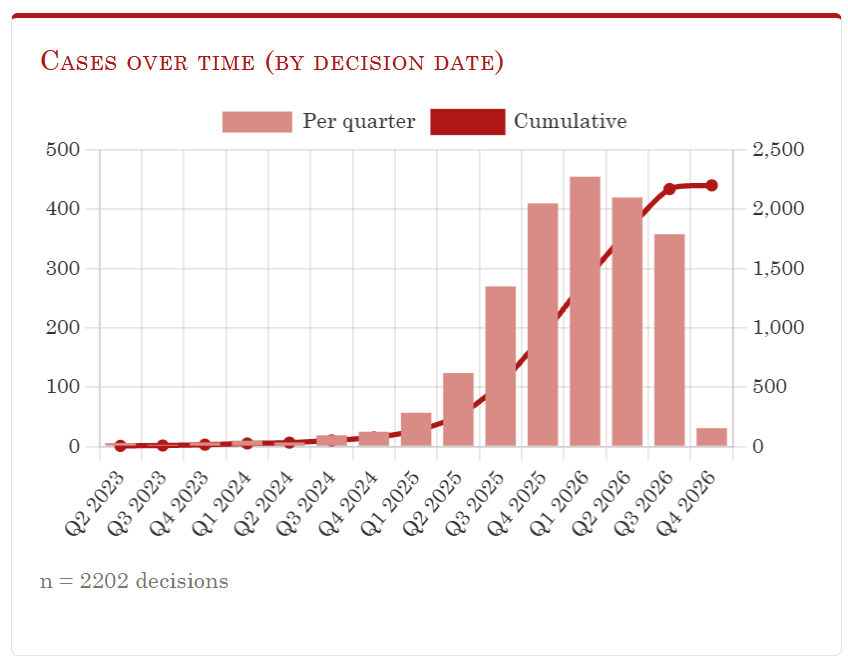
The first is, of course, thank God ! Maintaining the database is not too taxing, but exponential growth filled me with dread - and seemingly that’s now behind us.
Second, it is interesting to go into the probable causes. One of which, it goes without saying, could be my own failings - I may be missing new cases, and I am indeed lagging in proactively scouting for cases that are probably out there in some jurisdictions. But even accounting for my utter and despicable laziness in this respect, I doubt the exponential trajectory of the past year is continuing in the background.
Part of the reason lies in the progress on the model front: new LLMs hallucinate less. In a recent experiment, researchers asked various models to generate legal documents, and saw the hallucination rates decrease substantially, though never to zero and not in a smooth path forward: newer models may hallucinate a tad more than the previous generation (but far from the rates we saw in even-earlier models). Add this to the millions spent by legal tech tools to ensure auditability and verification, and it is likely that hallucinations are simply sparser at the source.
Which meets another possible reason for the downturn, one reassuringly behavioural: you must live under a special kind of impenetrable rock not to know that LLMs hallucinate, and if that’s the case, the increasing number of standing orders and guidance by judges and tribunals across the world should probably update you in turn. Indeed, while doing US database searches I increasingly come across decisions where a filing is simply struck because it lacks the required AI disclosure, regardless of whether AI has indeed been used, let alone hallucinated.
On the other hand, some kind of hallucination fatigue may have also taken place, with people not noticing them when they are not important or no longer unexpected. Not fewer cases, but fewer to report or to identify at all.
All this is slowly sketching a future I have already described elsewhere: where hallucinations become a new “cost of doing business”, something smart and sophisticated actors will guard against, while reckless ones fall prey to it.
But more generally, we may be moving from legible AI errors to illegible ones. Fabricated cases were always the easy part, the one that would (mostly) go away on its own. The subtler error modes of AI, by contrast, may take centre stage: sycophantic models giving you too much of what you asked for, or inputs optimised to trip you up. This is harder to collect in a database, but count on me to try.
As Pascal famously put it, “[t]out le malheur des hommes vient d’une seule chose, qui est de ne savoir pas demeurer en repos dans une chambre.”
The same is true, note, of quality: in a world where AI writing is excellent and pleasant to most readers, quality may turn to mean less “competence” or “exhaustiveness” and more “individuality” or even “expectation-defying”. On this, see here.
My own model of models is that they frequently act out a given persona, and will always clock Chekhov’s gun, which means that they could very well only mimic alignment and a concern for welfare. But I am also not sure that we should be worried that such concerns are only skin deep, as long as they are never betrayed. After all, “l’hypocrisie est un hommage que le vice rend à la vertu”.